On Building Self-Trust

Written by CTRR Practitioner Kim June Johnson
To learn more about working with Kim, click here.
Self-trust is a topic that often needs addressing in religious trauma recovery. How do we build self-trust when we were conditioned to believe that looking inward was wrong and that trusting our hearts would lead us into deception? If we learned to aim our gaze outward—at leaders, or scripture, or faith community members—and that consulting our own internal compass was dangerous, self-trust can take some time to (re)build.
The Jungian psychologist and author, James Hollis, says this:
“If I have not had my worth affirmed I will fear failure, avoid success and program myself to a repetitive cycle of evading the tasks of life. Even if I feel no floor beneath me, I still must take step after step, laying down a strip of accomplishment each time until I have built my own floor.”
That's about as good a description as I've ever heard on the process of building self-trust.
But a pattern I see in a lot of my clients is that they push themselves too hard. They want those strips laid down! And in the process, they get overwhelmed with too many insights, excess urgency, and information overload. Growth and expansion stops feeling good and begins to feel bad or even scary.
Sometimes self trust looks like holding onto the edge of the pool.
When my daughter was learning to swim, she was scared of the water. She wore a life jacket for a long time, and when she got used to it, I switched her to water wings, and she wore those for a good long while. When she felt ready to try swimming on her own without the water wings, she stayed close to the edge of the pool. She would tread water for a few seconds and then grab the pool’s edge again. She did this over and over until the treading-water times got longer and longer, and finally, she was swimming on her own. Going at her own pace, she learned to trust herself. This gave her the capacity to stretch herself in her own time and eventually reach a new skill level.
Self-trust is not just built through expansion. It’s also built when we honour our limits.
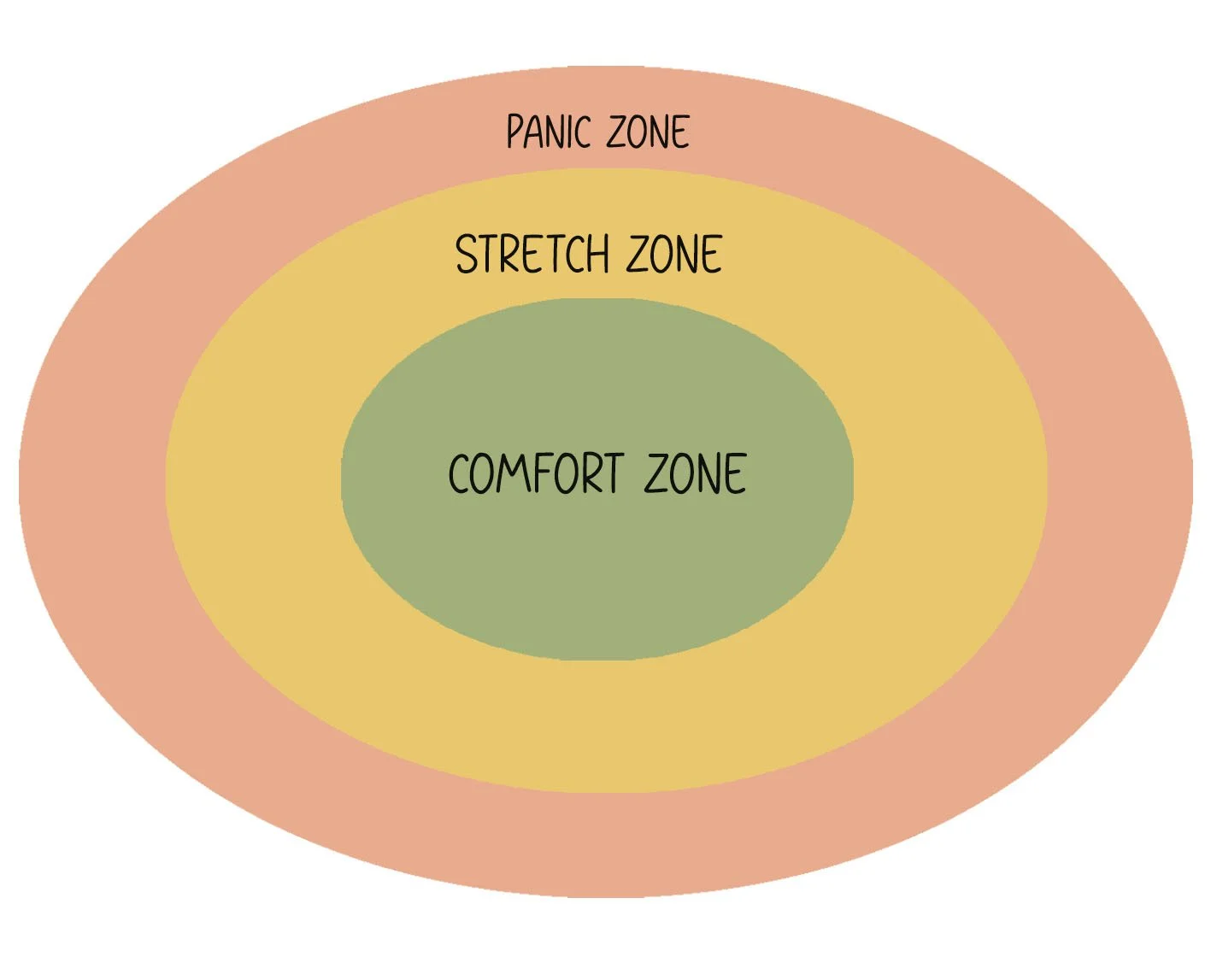
Some years ago, I attended a creativity workshop where the instructor introduced us to Tom Senninger’s three-zone model, which illustrates how people approach stages of growth.
The Comfort Zone
The comfort zone is easy, predictable, familiar, restful, relaxing. We feel confident there, but sometimes it can feel dull and stifling. Eventually, most of us want to expand and grow. This takes us into the stretch zone.
The Stretch Zone
The stretch zone is engaging, exciting, expansive, but also unfamiliar, uncertain and challenging. When we get tired of the stretch zone, we return to the comfort zone to rest and recuperate.
The Panic Zone
Sometimes we go beyond the stretch zone into the panic zone. This is when overwhelm happens. Maybe it’s from too much uncertainty, limited skill or not enough support. We have the urge to retreat. And what’s important to know about the panic zone is that we don’t learn effectively there. If we spend too much time in the panic zone, our nervous system begins to hijack our growth. We might label this self-sabotage, but, really, it’s our body protecting us from overwhelm.
One person’s comfort zone might be another person’s stretch zone. I love acting in theatre productions but friends have told me they could never expose themselves like that. I know a man who climbs cliffs while strapped into a harness; his “comfort zone” on a mountainside would take me well past my panic zone.
The three-zone model gives us a framework for honouring our capacity, wherever we’re at. This can be a new concept to those of us who grew up in environments where we were pressured, through shame or fear, to override our limits—or conversely, were prevented from exploring life outside the strictures of family or religious community, making growth itself feel dangerous.
When we can recognize the felt-difference in our bodies between the three zones, we can give ourselves permission to move forward when we’re ready and pull back when we’ve reached our limit. This builds self-trust.
Kim June Johnson is a yoga therapist, mindfulness facilitator, somatic coach and associate practitioner at CTRR.
To learn more about working with Kim, click here.
Beginning Tuesday, March 17, Kim is offering two support groups: Reclaiming Your Life After Toxic Religion and Embodied Beliefs.
Reclaiming Your Life After Toxic Religion is part support group and part course, offering a supportive space for exploration and growth as participants learn to navigate their healing journey with clarity and intention. This support group is designed for individuals who are ready to deepen their recovery journey and thrive beyond the impact of religious trauma.
Embodied Beliefs will explore religious trauma through a mind-body lens, addressing ways in which we carry indoctrination injuries in both our minds and bodies. Each session will begin with 20 minutes of yoga and breath-work. Attendees will need a space where they can move.
Schedule a free 20-minute inquiry call with Kim to learn more and register!